‘Be human only, dish out the truth’ is the slogan of Berlin International Film Festival’s Forum programme, which since 1971 has been directing the spotlight on works that represent a critical reflection on the medium of film and that engage in artistic and socio-political discourse. This year the Forum Special Programme focuses on female directors. Kossuth and Balázs Béla Prize laureate Judit Elek, who died at the age of 87 on 1 October 2025, was one of the first, hugely influential Hungarian female directors.
A Hungarian Village is set in a small settlement in Heves County, where the majority of young people leaving elementary education submit to the will of the community: following the path taken by their parents and grandparents, young men go to work in the mine and young women get married. Judit Elek’s documentary concentrates on the daily struggles and opportunities of women who would prefer to shape their lives according to their own ideas, thereby putting themselves in the firing line. This unbiased, sociographic film observing processes at work brings human relationships, rebellion and acceptance, as well as the closed life of a small community, into a rarely seen close-up.
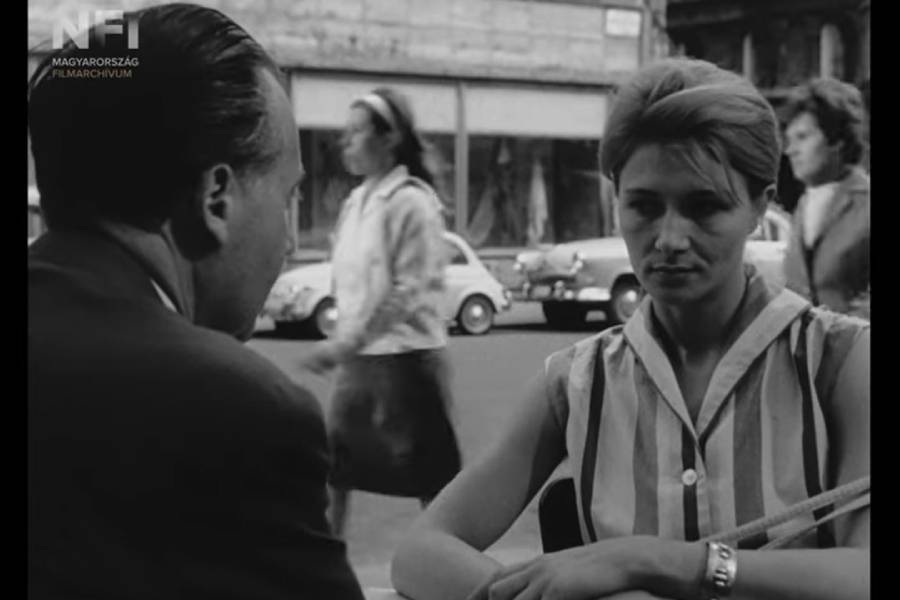
The short Encounter (1963) that sits on the boundary between fiction and documentary is about a rendezvous involving a lonely bachelor and a nurse. It manages to capture the basic difficulties, downright weirdness and awkward humour of dating and establishing relationships. Judit Elek shot the film in Balázs Béla Studio using the cinema direct method. The basic structure of the movie is given: two lonely people meet, they go out but the programme falls flat so they sit down in a café to talk about their real emotions. The male lead ‘plays’ the part of famous writer Iván Mándy; the female amateur actor was contacted through a classified ad.
Judit Elek (1937-2025) fell in love with film at an early age, spending all her pocket money on cinema tickets. She studied directing in the class of Félix Máriássy at the Academy of Drama and Film and launched her career as a dramaturg at Budapest Film Studio. She became one of the leading figures of Hungarian film history as a founding member of Balázs Béla Studio. Her 1967 documentary How Long Does Man Matter? (Meddig él az ember?) – photographed by Elemér Ragályi when still a high school student – won several major awards. Ragályi was similarly cinematographer for Elek’s first feature film, the hugely popular The Lady from Constantinople (Sziget a szárazföldön, 1969). She debuted as a screenwriter on the Zsigmond Móricz adaptation Viola (Árvácska, 1976). Following this she reverted to documentaries for a while, but from the 2000s she once again began shooting feature films – The Eighth Day of the Week (A hét nyolcadik napja, 2006) and the autobiographically inspired Retrace (Visszatérés, 2011). Her inimitable stylistic traits include blurring the lines between feature film and documentary, as well as blending fiction and reality. Elek’s works have featured at Cannes on four separate occasions and she in the winner of numerous prizes from European and international festivals.
In 2024 she was presented with a lifetime achievement award from the Hungarian Film Academy during the MOZ.GO Hungarian Motion Picture Festival.
The Hungarian National Film Institute – Film Archive oversees the preservation and distribution of the works of Judit Elek as well as the entire national film heritage. Experts from the National Film Institute – Filmlabor conduct digital restoration.