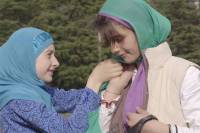
Marine Gulbiani is currently in production with documentary Before Father Is Back, a coproduction between France, Georgia and Germany.
At at ceremony in Tallinn tonight the 2017 awards of Industry@Tallinn &; Baltic Event were presented.
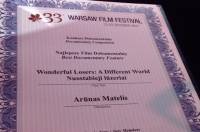
'Wonderful Losers. A Different World" by DGA-winner A. Matelis wins Best Documentary at Warsaw Film Festival
Festivals 24-10-2017
'Wonderful Losers. A Different World", from Lithuanian film director Arunas Matelis, was awarded the Best Documentary Feature at the 33rd edition of the International Warsaw Film Festival (WFF). As the winner at one of the top eight 'A' class film festivals (along with Cannes, Venice and Berlin) in Europe, Arunas Matelis' documentary will also be eligible in the selection for the European Film Academy Awards.
'Wonderful Losers. A Different World" uncovers the invisible side of "Giro d'Italia" - one of the harshest as well as one of the biggest cycling races in the world. Despite its popularity, few people know about the complex, hierarchal structure of the race which often bears similarity to monastic rules, including unconditional acceptance and self-sacrifice. The film focuses on cyclists who always ride in the back, carry the water for others and are destined to lose at the very beginning of the race - the so-called "gregarious"/"domestique", the monks of professional cycling, ready to overcome enormous challenges in order to help the leader of the team win the race.
"It's a film that immerses you into its world from the first seconds. With every frame the cyclists' pain becomes more and more that of your own, their wounds gradually become yours, and only when everything ends you are able to go back to your own reality. This story can be as mesmerizing even for those who don't fancy cycling races or don't even cycle themselves - it's about passion and sacrifice for a common goal, a sacrifice for another person", - claims Stefan Laudyn, the director of the WFF.
Film director Arunas Matelis highlights the importance of winning the Best Documentary Feature at the WFF, claiming that the stories selected by this festival are among the most powerful in the world. Winning in the competition programme is a remarkable accomplishment for any film director, and he feels honored to have been able to present an eight-year long production to the international audience.
"The film lasts 71 minutes and it took me the same amount of time to answer the questions from the audience. The applause it received goes not only for me but for the whole team too, as they all showed outstanding determination and ambition at work despite the difficulties we faced, e.g. extremely dynamic and complex shooting conditions. It would have been impossible to make this film without my amazing crew," - says A. Matelis.
The premier at the WFF received positive response from the audience, as many viewers appreciated the fact that the director had the courage to
draw the backstage curtains of the enduring cycling races. It was the first time somebody had chosen to use the language of cinema to talk not about the winners who usually take all the credit, but rather about those who stay in the shadow. These "gregarious"/"domestique" opened up their hearts to the director and let him watch their daily routine - exhausting training and strenuous races where there's not even a chance for a personal victory, only the duty to overcome the harshest challenges in order to help your team's leader triumph.
"How did you manage to get so close to the heroes of your film?" was among the most popular questions at the first screening. A. Matelis admitted that gaining cyclists' trust was among the most difficult tasks for the whole crew. "Days and even weeks had to pass before the "gregarious" started to notice our persistence to capture the smell of sweat instead of the taste of victory. Very often we had to shoot in the most dangerous conditions and risk the safety of the crew. I believe this is what finally made the heroes fully trust our intentions", - claims the director.
"Wonderful Losers. A Different World" is one of the most complex and riskiest documentary projects in Europe - it's been 40 years since any film director was given the permission to shoot the race from the inside with his own crew. Once there was a green light, the Italian press had been extremely interested in the development of this project. "None of my awards or earlier films have earned as much attention in Italy as "Wonderful Losers. A Different World", - adds the author of the film with a smile.
"Arunas Matelis takes a risky move: he speaks not about the winners, but instead - the sweat-pouring sportsmen who remain in the shadow", - still in astonishment the Italian daily newsletter La Repubblica recently wrote.
"I was intrigued to understand those who cross the finishing line second though could be there first, those who choose to be someone else's sword-bearers. It's hard to imagine a bigger paradox - years after years the sportsmen undergo rigorous training and aim for constant improvement just for the sake of someone else's victory. Even before the actual shooting began I saw this phenomenon as a universal topic. A conscious sacrifice for another person. Honestly, it's not even important whom we are talking about - the cyclists who set aside their ambitions to win, somebody in a couple who gives up his/her career for another's welfare, a mother who stays at home to bring up her kids or children who sacrifice their lives to take care of their ill parents. At the end of the day, the criteria defining the winners in each situation become even more unclear", - says Matelis.
Up until Arunas Matelis was allowed to observe the "Giro d'Italia" race from within, the last independent filmmaker to do so was Jorgen Leth, director of the legendary film "Stars and Watercarriers", released in 1973.
"Getting a permission to shoot the famous race after a forty-year gap was a huge challenge and an outstanding victory at he same time. It was only when the shooting began did we understand why "Giro d'Italia" takes place in a closed and carefully guarded terrain where nobody, except for the sportsmen, their teams and medical-car doctors medical were allowed to enter",- admits the director.
Arunas Matelis, a well-known documentary film director, has already been recognized in the international film community for his earlier films. Numerous significant prizes include the "Directors Guild of America" award for "Outstanding Directorial Achievement in Documentaries", making his "Before Flying Back to the Earth" the best documentary in the world in 2007. Interestingly, this was also his last film before the "Wonderful Losers. A Different World". Hoping for new, captivating stories from Arunas Matelis, the members of the Directors Guild of America were surprised and confused to receive nothing for a long time.
"It took me four years to start shooting a new film. "Before Flying Back to the Earth" was born out of my own painful personal experience. For years it felt as if I am not allowed to tell a new story unless it touches me personally as much as the previous one. Many times I would arrive at a location to shoot and find myself unable to even touch the camera for the fear that I won't be able to put all of myself into the new film. Gladly, the idea for "Wonderful Losers. A Different World" changed everything and brought back the desire to create again. Cycling is my childhood dream that never came true", - admits the director and delivers a story full of personal experience encrypted in the symbolic language of cinema.
The film "Wonderful Losers. A Different World" is the biggest European co-production so far. Initiated by Arunas Matelis' own production house "Studio Nominum" (Lithuania), the film was co-produced with an array of foreign countries, including Italy, Switzerland, Ireland, Northern Ireland, Latvia, Spain and Belgium.
The premier at the International Warsaw Film Festival was made possible thanks to the Lithuanian Film Center, Audiovisual authors and producers rights association "AVAKA", and the Embassy of the Republic of Lithuania to the Republic of Poland.
The national premier in Lithuania is expected to be held at the beginning of 2018.
The Black Nights Film Festival completes the lineup for the First Feature Competition programme
Festivals 24-10-2017
Adding to the previously announced five titles, the Black Nights Film Festival announces 11 others that will be part of the First Feature Competition programme, including Brazil’s candidate for the Academy Awards.
Entering it’s third year, the First Feature Competition is an international competition programme for first-time feature directors that will see a six-member jury handing out the award for best film and two special jury awards for outstanding achievements in whichever category the jury deems worthy of complimenting.
According to Tiina Lokk, the head of programme of the festival, a standout quality of this year’s selection is the maturity of the authors, both in terms of how they handle their topics, how they generalise and how they apprehend the whole of the film. ‘It has less of the youthful bravado than previous years, being more mature and balanced. Although we have managed to get great debuts every year, I believe the programme as a whole has made a qualitative step forward.’
‘But it is also a somewhat calmer and inward looking year, as fierce statements on bigger, geopolitically relevant social issues such as the economic crisis and refugee crisis of last year have been substituted for close relations, the overcoming of generational differences, forgiveness and finding each other’, she added.
Having made an impressive career as an editor (Tree of Life, City of God, Motorcycle Diaries) and having won the BAFTA and been nominated for an Academy Award for his work on the film City of God, director Daniel Rezenda presents his feature debut as a director - Bingo. It is an ecstatic story of a man who’s driven to prove his artistic talent, becoming the most successful clown in television history, but with a hefty psychological toll. The film, based on a true story, is Brazil’s candidate for the Academy Award.
Another entry from Brazil in the competition, Neurotic Quest for Serenity is the feature debut of Paulinho Caruso and Teodoro Poppovic, a lively, satirical take on the the world of modern show business, exposing all its operational mechanisms and societal effects with intelligent glee. The story centers on an A-level film and a TV actress reaching her career’s first psychological crisis after receiving an encrypted letter from her ghostwriter.
Icelandic director-scriptwriter Guðrún Ragnarsdóttir’s opens the world of children and their fantasies with a delicate and imaginative touch in Summer Children, a tale that is set in the 1970’s and based on personal experiences. A pair of siblings, five and six years old, are sent to a countryside summer camp after their parents’ divorce. What was supposed to be a temporary solution drags on for longer than anticipated, up to the point where the children start to plan an escape from the repressive institution.
Having already visited several festivals with his documentaries and short films, Macedonian director-scriptwriter Gjorce Staverski offers a satirical critique of Eastern European “cowboy capitalism” in his black comedy Secret Ingredient. It is a tale about a train mechanic who uses a mob cannabis delivery he found on a decommissioned train to secretly relieve the pain of his cancer-suffering father. The project won the VFF highlight pitch award at the Berlinale talents market.
In Sunbeat directors and sisters Clara and Laura Laperrousaz create a deceptively sublime picture of a French family living in a sublimely scenic and rural part of Portugal, however, traumatic wounds that their parents have been suppressing gradually start coming to light, dangering the equilibrium of the family in the process.
Setting his film in Brussels, often dubbed as the mecca of radical islam in Europe director
Guérin van de Vorst studies people living on the fringes of society - the most likely groups to violently react to what they can’t understand or disagree with in the world. The Faithful Son is an character-driven tale of a father who is desperately trying to build the bridges that were burned between him and his son during the time he was imprisoned.
German director Isabel Prahl studies a case of European hikikomori as she offers portrait of a family sliding gradually into disarray after the 18-year-old son isolates himself in his room in Different Kinds of Rain. The mother, father and daughter each have their own way of reflecting, offering a multi-angled perspective on the disruption that a closed door can create.
In Nearest and Dearest the 27-year-old director and scriptwriter Ksenia Zueva offers a bleak yet heartfelt insight into a Russian urban family on the verge of breaking up. Through studying the stories of each of the family members sharing a small flat she has created a portrait of a family nearing dysfunctionality, while constantly offering acute reflections on the status quo of the surrounding society in general.
Drawing some creative ideas and themes from Chekov’s classic play of the same name and rearranging them playfully for his own purpose, Turkish director-scriptwriter Erkan Tunç presents his ‘dramedy’ The Seagull, that has already seen some success at domestic festivals, winning an award for its imaginative script at Ankara Film Festival. The film studies the silent clash of urban/liberal and rural/conservative Turkeys in the affairs of two couples on a remote chicken farm.
Having personally spent years in the ultra orthodox Jewish town Bnei Berak, director Yehonatan Indursky offers a rare insight into the marginal spheres of Israeli society in Driver. Ruzumni works as a driver, taking people who need money from one wealthy member of the community to the next. The aim of the visits is to get as much money as possible. Ruzumny teaches his clients to tell stories that make listeners especially generous. He does this while trying to raise his daughter as a single father.
Having a background in directing for TV Shows and commercials (including an award-win at Cannes Lions) Yukihiro Morigaki’s debut Goodbye, Grandpa! is a light, pastel-colored take on the dread of being a teenager and processing things like losing one’s grandfather or having an awkward family.
Films that were announced on the 20th of September:
Buddha.mov
Kabir Mehta’s experimental documentary follows a flamboyant Goan cricket player in his daily activities, exposing explicitly even the most intimate details of his private life, including screenshots of his social media feed and intimate encounters with women, thus depriving the subject of any privacy and expanding the boundaries of the portrait documentary.
The project (previously called Buddhagram) was awarded with the Facebook Award at last year’s Film Bazaar. The director has won awards at the European Media Art Festival and Ann Arbor FF for his previous project.
Home
Director Kim Jong-woo’s drama sets a rather unique premise: a man’s current and former wife get into a car accident and are both left in a coma. The man finds it easy to accept the daughter he had with the ex-wife, but a more problematic issue is the boy - the protagonist of the film - whom the ex-wife had from a previous marriage. What follows is a moving study on the meaning of family, acceptance and having a safe place - a home. The director’s short films have been part of several film festivals, including Busan International Film Festival.
Resurrection
Representing the focus region of the festival this year - Flanders, Belgium - Resurrection follows a young man who has just murdered his companion and is united with a reclusive man who offers him a hideout. Director Kristof Hoornaert’s presents a quiet, touching tale of the repercussions of violence and of overcoming one’s past demons.
The director’s short films have been screened at numerous festivals, including Berlinale, Tallinn Black Nights, Montreal, Busan and BFI London.
The Heat after the Rain
Cristóbal Serrá Jorquera’s first feature film follows 30-year-old Julia who is trying to restore her mental balance after a miscarriage and the ensuing breakup from her companion. It is a rare case of a male director studying a female subject with subtle delicacy, offering a film that serves both as a meditative journey and a moving character piece.
The director has previously been awarded at the Valdivia IFF for his short film Todos los lugares y yo.
The Marriage
Kosovan director Blerta Zeqiri’s fascinating character study centers on two friends who were separated after the Kosovo War and are reunited on the eve of the marriage of one of them. After a successful first encounter with the friend and his bride to be, the events and revelations take an unexpected turn that threatens to alter the triangle’s current state of affairs.
The director’s short films have won awards at international festivals such as Sundance, Sarajevo and Tirana.
Bingo (Bingo: o rei das manhãs), dir Daniel Rezende, Brazil, 2017 - International premiere
Buddha.mov, dir Kabir Mehta, India, 2017 - World premiere
Different Kinds of Rain (Tausend Arten, den Regen zu beschreiben), dir Isabel Prahl, Germany, 2017 - World premiere
Driver (Lifney Hazikaron), dir Yehonatan Indursky, Israel-France, 2017 - World premiere
Goodbye, Grandpa! (Ojichan, shinjattatte!), dir Yukihiro Morigaki, Japan, 2017 - International premiere
Home, dir Kim Jong-woo, South Korea, 2017 - International premiere
Nearest and Dearest (Blizkie), dir Ksenia Zueva, Russia, 2017 - International premiere
Neurotic Quest for Serenity (TOC: Transtornada Obsessiva Compulsiva), dir Paulinho Caruso, Teodoro Poppovic, Brazil, 2017 - International premiere
Resurrection, dir Kristof Hoornaert, Belgium, 2017 - International premiere
Secret Ingredient (Исцелител), dir Gjorce Stavreski, Macedonia - Greece, 2017 - International premiere
Summer Children (Sumarbörn), dir Guðrún Ragnarsdóttir, Iceland-Norway, 2017 - International premiere
Sunbeat (Soleil Battant), dir Clara Laperrousaz, Laura Laperrousaz; France, 2017 - International premiere
The Faithful Son (La Part Sauvage), dir Guérin van de Vorst, Belgium, 2017 - International premiere
The Heat After The Rain (El calor después de la lluvia), dir Cristóbal Serrá Jorquera, Costa Rica, 2017 - International premiere
The Marriage (Martesa), dir Blerta Zeqiri, Kosovo - Albania, 2017 - World premiere
The Seagull (Martı), dir Erkan Tunç, Turkey, 2017 - International premiere
KARLOVY VARY’S EAST OF THE WEST COMPETITION OPENS TO FILMS FROM THE MIDDLE EAST. FESTIVAL INTRODUCES ‘EASTERN PROMISES’ INDUSTRY PLATFORM
Festivals 24-10-2017
- Films and projects from the Middle East will now be eligible to enter the East of the West Competition and the Eastern Promises Works-in-Progress pitching
- Treated projects-in-development from Central and Eastern Europe will be showcased for the first time thanks to a new
- Submissions for the 53rd Karlovy Vary International Film Festival open on 1 November
As a part of strengthening its unique position as a gateway to success for Eastern European film, the Karlovy Vary International Film Festival is looking further east to cover new film territories for its East of the West Competition. This section, which focuses on first and second films and regionally covers Central and Eastern Europe, the Balkans, the former Soviet states, Turkey, Greece and Cyprus, will now be enriched by films from the Middle East. Films from Bahrain, Egypt, Iran, Iraq, Israel, Jordan, Kuwait, Lebanon, Oman, Palestine, Qatar, Saudi Arabia, Syria, the United Arab Emirates and Yemen will now be eligible for the East of the West Competition Grand Prix and the Special Jury Prize.
Artistic Director Karel Och comments on this decision: “We see significant potential among young filmmakers from the Middle East and would like to offer them a helping hand at the beginning of their careers. It is also about time to abandon the political definition of the ‘East of the West’ countries and to switch to a more geographical definition. Boundaries in film should be practical, not ideological.”
The festival’s film industry section is rebranding itself and starting with the 53rd KVIFF will be known as Eastern Promises @KVIFF. The promising projects in post-production presented in Eastern Promises will now reflect this new territorial definition within its traditional Works in Progress section. Additional pitching forums, added as part of an expanded industry programme, will continue to focus predominantly on the region of Central and Eastern Europe.
KVIFF recently joined forces with the Trieste Film Festival’s Eastweek and When East Meets West industry platforms and with the MIDPOINT script development programme to provide market opportunities for nine fresh projects that have undergone workshops on
Film Servis Festival Karlovy Vary, Panská 1, 110 00 Praha 1, Czech Republic
Tel. +420 221 411 011, 221 411 022
development, financing and co-production opportunities. These projects will be showcased in Karlovy Vary for the first time. Emerging film professionals who are working on their first or second feature film can submit their scripts via MIDPOINT’s website until 26 October 2017.
General submissions for the 53rd Karlovy Vary International Film Festival open on 1 November 2017. Filmmakers are encouraged to submit feature-length fiction and documentary films completed after 1 July 2017. Regular entries will be accepted until 28 February 2018, and late submissions can be made until the end of March via our website, www.kviff.com.
Four Animation Films and Four Comedies Nominated for the European Film Awards 2017
Press releases 24-10-2017
The European Film Academy proudly announces the four nominations for the award categories EUROPEAN ANIMATED FEATURE FILM 2017 and EUROPEAN COMEDY 2017.
Nominated for European Animated Feature Film 2017 are:
ETHEL & ERNEST by Roger Mainwood (UK, Luxembourg)
LOUISE BY THE SHORE (Louise en hiver) by Jean-François Laguionie (France, Canada)
LOVING VINCENT by Dorota Kobiela & Hugh Welchman (Poland, UK)
ZOMBILLÉNIUM by Arthur de Pins & Alexis Ducord (France, Belgium)
Nominated for European Comedy 2017 are:
KING OF THE BELGIANS by Jessica Woodworth & Peter Brosens (Belgium, Netherlands, Bulgaria)
THE SQUARE by Ruben Östlund (Sweden, Germany, France, Denmark)
VINCENT AND THE END OF THE WORLD (Vincent) by Christophe van Rompaey (Belgium, France)
WELCOME TO GERMANY (Willkommen bei den Hartmanns) by Simon Verhoeven (Germany)
The nominated films will soon be submitted to the more than 3,000 EFA Members to elect the winner. The European Comedy 2017 and the European Animated Feature Film 2017 will then be presented at the 30th European Film Awards Ceremony on Saturday, 9 December, in Berlin.

dok.incubator workshop calls for ambitious feature docs at the rough‐cut stage
Press releases 24-10-2017
dok.incubator, an international documentary workshop that supports the creative team (director, producer, and editor) with their late-stage documentaries, is searching for original film projects that will have a rough-cut ready by March 2018.
The programme is based on individual tutoring for the whole team. Under the supervision of experienced European experts of editing, production and marketing, you will work on sharpening the storytelling of the final cut, and devising a clever marketing and distribution strategy.
Apply now to develop your rough-cut into an outstanding feature film with a tailor-made release and distribution strategy.
DEADLINE: 31st January 2018
Meet us to discuss your film project at:
- Jihlava IFF: October 24th - 29th
- DOK.Leipzig: October 30th – November 1st
- IDFA: November 16th – 21st
To schedule a meeting, please contact This email address is being protected from spambots. You need JavaScript enabled to view it..
Putting a spotlight on a record number of 28 European Oscar entries, EFP (European Film Promotion) offers additional screenings of the films in LA for Academy members, journalists, US-distributors and international buyers. With the special support of the EFP member organisations, the event helps the productions to stand out among a record number of 92 submissions for the 90th Academy Award for Best Foreign Language Film. This year the EFP SCREENINGS OF OSCAR ENTRIES FROM EUROPE are held from November 2 - 15 at a new location, the state of the art Dick Clark Screening Room. The campaign is financially supported by the Creative Europe - MEDIA Programme of the European Union and the participating EFP member organisations.
Many of the European Oscar submissions feature European Shooting Stars or were made by EFP-related filmmakers. Notably four films were realized by participants of this year's edition of Producers on the Move (POM), such as the Georgian feature film debut, SCARY MOTHER, by Ana Urushadze, which was produced, amongst others, by Lasha Khalvashi. His fellow participant Gints Grube from Latvia realized THE CHRONICLES OF MELANIE, a wartime drama depicting the deportation of the Baltic people during the Stalin era. Alan Maher produced SONG OF GRANITE, the formally inventive portrait of traditional Irish singer Joe Heaney, while Maria Blicharska from Poland produced the Lithuanian submission FROST together with colleagues from Lithuania, France and the Ukraine.
Tallinn Black Nights announces the lineups of five juries that will be judging three competition programmes of the festival and evaluate films in several other categories.
The Official Selection will consist of seven members: produver Zeynep Atakan, PR and marketing consultant Dennis Davidson, director Naoko Ogigami, sriptwriter Graziano Diana, composer Zygmunt Krauze, director Laila Pakalnina and producer Ivo Felt. They will select the winner of the grand prize of the festival that includes a grant of 10 000 euros and eight other awards for best director, cinematography, script, actress, actor, music and production design.
The First Feature Competition will see the return of director Eitan Anner who’s film A Quiet Heart was awarded the Grand Prix at the last edition of Black Nights. He will be joined by festival director Takeo Hisamatsu, actresses Tiina Mälberg and Aiste Diržiute, producers Fernando Loureiro and Guillaume de Seille who will decide on three awards: best film and two special jury prizes.
The NETPAC (Network for the Promotion of Asian Cinema) will select the best Asian film in the programme, selected from the lineup of the Official Selection, First Feature Competition and the Asian world premieres in the other sections. Its members are journalists Keoprasith Souvannavong and Lekha Shankar and director Martti Helde.
FIPRESCI (International Federation of Film Critics) jury represents the voice of film critics. They pick their favourite from the First Feature Competition. The members for the 2017 edition are Kristin Aalen, Kata Orsolya Molnar and Emilie Toomela.
The Ecumenical jury brings together representatives of five major Christian churches and confessions in Estonia to highlight a film in the Official Selection that, through its script, performances or production notably represents Christian principles or general human principles beyond specific world views, an emphatic and mutually considerate attitude to life, traditional life values and the sanctity of life. The jury members are Andres Põder, Stefanus, Jaan Tamsalu, Erki Tamm, Indrek Sammul and Madis Kolk.
SHORT BIOGRAPHIES
Official Selection
Zeynep Atakan is a Turkish producer who has worked with director Nuri Bilge Ceylan’s since 2006, including Once Upon A Time In Anatolia and Winter Sleep that won the Palme d’Or at Cannes film festival. Atakan won the European Film Academy’s Best European Co-Producer Award in 2010. She’s the Vice President of European Women’s Audiovisual Network Atakan and directs the Antalya Film Forum.
Dennis Davidson is a British PR and marketing consultant and the Founder of the DDA group of companies. His long list of credits include American Hustle, Jupiter Ascending, Cloud Atlas, Snowden, American Pastoral and Netflix series Sense8.
Graziano Diana is an Italian scriptwriter, writer and director whose work includes the scripts of Ultrà that won Silver Bear at the Berlinale and La scorta that was nominated for Palme d’Or at Cannes film festival.
Zygmunt Krauze is a renowned Polish composer whose work includes six operas, instrumental forms from miniatures to solo concertos, symphonic works engaging hundreds of musicians, music for theatre and film, choral pieces and spatial compositions.
Naoko Ogigami is a Japanese director whose films Glasses and Barber Yoshinohave won several awards at the Berlinale and have been screeened at PÖFF. Her most recent work Close-Knit will also be screened at this year’s PÖFF.
Laila Pakalnina is a Latvian director and scriptwriter who’s films have screened at Cannes, Venice, Berlinale, Locarno, Karlovy Vary and her last full-length feature Dawn premiered in the Main Competition competition of PÖFF.
Ivo Felt is an Estonian producer whose CV includes Tangerines that was nominated for an Academy Award and a Golden Globe in 2015 as well as The Fencer, nominated for a Golden Globe in 2016. Both films have won the Best Estonian Film award at PÖFF.
First Feature Competition
Eitan Anner is an Israeli film and TV director, scriptwriter and lecturer. His film A Quiet Heart won the Grand Prix and Best Actress award for Ania Bukstein at last year’s PÖFF.
Takeo Hisamatsu is the director of Tokyo International Film Festival, who has worked for the Shochiku Broadcasting Co and Warner Bros. Pictures Japan. He has participated in the production of films Unforgiven, Air Doll, Love, Honor and runs the production company My Way Movies.
Tiina Mälberg is an Estonian theatre, TV and film actress and lecturer on stage speech. She played the leading role in Mother (Best Estonian Film award at PÖFF 2016) for which she was awarded the Best Leading Female Actress award at the Estonian Film and TV Awards.
Aiste Diržiute is a Lithuanian actress best known for her role in The Summer of Sangaile, that screened at Sundance and the Berlinale in 2015, where she became the first Lithuanian actress to participate as one of the European Shooting Stars. She has a a supporting role in the biographical drama Kharms that will be screened at PÖFF this year.
Guillaume de Seille is a French producer who slate of more than 40 films includes titles like Much Ado About Nothing, I, Olga Hepnarova and Zoology that screened at PÖFF last year.
Fernando Loureiro is the co-founder of the L.A.-based production company Exhibit. His work includes Sweet Virginia (will be screened at PÖFF this year) and Thump-er, both of which premiered at the Tribeca Film Festival.
NETPAC
Keoprasith Souvannavong has worked as a radio, TV and written press journalist and chief multimedia Editor at Radio France Internationale. In 1993 he played a role in Tran Anh Hung‘s The Scent of Green Papaya that won two prizes at the Cannes Film Festival and was nominated for an Academy Award.
Lekha Shankar is Bangkok-based Indian film journalist and programmer. She has worked as programmer of the International Film Festival of India and writes currently on cinema for several publications in Thailand and India.
Martti Helde is an up and coming Estonian film director whose first feature In the Crosswind was selected for the international Toronto Film Festival and won several awards at PÖFF.
FIPRESCI
Kristin Aalen is a Norwegian journalist and film critic and creator of the website www.kulturkritikk.no.
Kata Orsolya Molnar is an editor, journalist and a branding and communications expert from Hungary. She is the editor-in-chief of the leading independent Hungarian online movie magazine Filmtekercs.hu.
Emilie Toomela is a freelance film journalist writing regularly for both Estonian and Baltic outlets.
Ecumenical Jury
Andres Põder
Estonian Council of Churches, President Archbishop Emeritus
Stefanus
Estonian Apostolic Orthodox Church, Metropolitan
Jaan Tamsalu
Pastor of St. John`s congregation and rural dean of Tallinn
Erki Tamm
Union of Free Evangelical and Baptist Churches of Estonia, President Reverend
Indrek Sammul
The Bishopric of the Estonian Orthodox Church of Moscow Patriarchate, actor
Madis Kolk
The Estonian Apostolic Orthodox Church, Editor-of-Chief of magazine Teater. Muusika. Kino
Tallinn Black Nights Film Festival unveils the opening film and Flanders Focus lineup
Festivals 02-11-2017
The 21st Tallinn Black Nights Film Festival (aka PÖFF) will see Flanders, Belgium as the focus region of the festival, that will include 10 films in the specially-curated programme In Focus: Flanders. The festival will be opened with another film from the region, Racer and the Jailbird.
Following the tradition of choosing a country of focus for each edition to introduce slices of its culture and cinematic history, PÖFF has instead focused on a region this time, choosing the Dutch-speaking region of Belgium - Flanders - as its region of focus for 2017. The festival has curated a retrospective programme of 10 films that explore the developments in Flemish cinema between 1983 and 2016.
The programme includes two Best Foreign Language Film Academy Award nominations - Daens by director Marc Didden (1983) and Bullhead by Michaël R. Roskam (2011), the only film in the programme that has screened at PÖFF before. One of the films, Facades by directors Kaat Beels & Nathalie Basteyns, will have its international premiere at the festival.
Other entries include the winner of the best director award in Venice’s Orizonti competition Home by director Fien Troch, Cargo that was nominated for the Sebastiane award at San Sebastian and Toto the Hero, a co-production between Flemish, Walloons and Germans, that was nominated for a BAFTA and won the Golden Camera award for the director Jaco van Dormael at Cannes in 1991.
The film to be screened at the opening ceremony of the festival on 17 November in the Nordea Concert Hall is Racer and the Jailbird, the romantic heist thriller by director Michaël R. Roskam that had its world premiere in Venice. The film has been chosen as the Belgian candidate for the Academy Award for Best Foreign Language Film.
Says Tiina Lokk, director of Black Black Nights Film Festival: ‘Why Flanders? Because it is a remarkable region with a rich cultural heritage and an exciting cinematic output. What I, as an Estonian, admire especially is how they have made a much greater impact in the world than their size would seem to suggest. They’ve been making great, distinctive films for decades now, having put themselves strongly on the map with two Academy Awards nomination in the last decade and a remarkable presence at the festival circuit.
And their films have always made a strong impact our festival’s audiences and juries alike. To bring some examples, in 2012 Felix van Groeningen’s Broken Circle Breakdown won the audience award, in 2014 Gust van den Berghe’s Lucifer won the Grand Prix and in 2015 Martha Canga Antonio won the best actress award for Black. In addition, we have a great Flemish debut Resurrection in this year’s First Feature Competition programme.’
Says Yves Wantens, General Representative of the Government of Flanders:
‘The kind of Flanders Focus with Black Nights is one of the bigger events we have initiated with a film festival. The reputation and the quality of the PÖFF festival was one of the elements to decide on this collaboration with PÖFF.
From the side of the Flemish Government we try to promote the internationalization of our movies and audio visual series from a cultural and an economic side and participation in festivals like PÖFF is also one way of promoting our movies to the international public.’
The focus is supported by the Government of Flanders, the Flanders Audiovisual Fund and Screen Flanders.
The tickets for the Flanders Focus films are now available at poff.ee.
Tallinn Black Nights Film Festival takes place from 17 November until 3 December.
In Focus: Flanders
Brussels by Night (1983), director Marc Didden
Crazy Love (1987), dir Dominique Deruddere
Toto the Hero (Toto le héros, 1991), Jaco van Dormael
Daens (Daens, 1992), Stijn Coninx
The Misfortunates (De helaasheid der dingen, 2009), Felix van Groeningen
Bullhead (Rundskop, 2011), Michaël R. Roskam
Home (2016), Fien Troch
Past Imperfect (Le passé devant nous, 2016), Nathalie Teirlinck
Cargo (2017), Gilles Coulier
Facades (Façades, 2017), Kaat Beels & Nathalie Basteyns