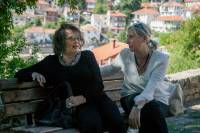
THE KOSOVAR ACADEMY AWARD CANDIDATE PRESENTED AT THE MANAKI BROTHERS FESTIVAL, CLAUDIA CARDINALE AMAZED BY THE CITY OF OHRID
Festivals 25-09-2018September 25, Bitola – Today’s festival day started with the introduction of the film from the European Cinema Perspectives program, The Marriage and the director Blerta Zeqiri.
This is a Kosovar film which showcases an unusual love triangle, where, only two weeks before Anita and Bekim’s wedding, Bekim’s secret lover, Nol comes to town.
-The film opens up a subject of which existence we are not aware, but it is more at the margins of the society. The problem the LGBT community faces is quite boldly treated. Although it has all the aspects of a Balkan community, there are very beautiful patriarchal scenes, treating the traditional values, because the people in the audience aren’t always ready to see scenes of two male actors making love, Slagjan Penev, selector of the European Cinema Perspectives program, said.
The film The Marriage is the first feature film of the director Zeqiri and it had quite a great success at festivals so far.
-The influence by the actors was quite big in the making of the script, but I also want to point out their bravery to accept being part of this project because when we started to prepare the film in 2012-2013, there was a big accident at a party in Kosovo promoting an issue devoted to the LGBT community. A large group of extremists came by, wrecking everything, and some people were beaten up. That is why we were also terrified that something similar might happen to us considering the subject of the film. We kept the film a secret, the media didn’t know the theme, but they helped us by not publishing anything until we finished the film. A great deal was done also by the actors Alban Ukaj, who is very popular, who has worked abroad and is known as the Kosovar Brad Pitt, everyone loves him, and the role of Nol, the lover in the film, is played by the Kosovar rock-star Genc Salihu, Zeqiri said.
The cinematographer Lukas Milota spoke about the film Winter Flies, which was screened last night as part of the Golden Camera 300 competition. The film and cinematographer were introduced by the selector of the official program of the Festival, Blagoja Kunovski – Dore.
-The children are not professional actors. Working with them was quite a long process, the rehearsals lasted more than six months, but at the end we got the effect of teenage adventurers who set off south across the frozen landscape in search of an adventure, Milota said. He is present at the Manaki Brothers festival for the second time.
Milota said that he used an ALEXA Mini camera, because it was quite compact and easy to handle, especially for this film.
Marija Apchevska introduced two film crews from the short films selection. The director of the film Birch, Paisley Valentine Walsh spoke of the idea of the film.
-The childhood memories were the main idea to shoot this film. We tried to stay close to the memories the whole time, Paisley said.
The film is shot on a filmstrip, which is very hard.
-The harder thing is the fact that you also have a dog and two children and you don’t have the opportunity to shoot the scenes multiple times. We made the choice of working on filmstrip because we think that it gives more connection to the audience, Vincenzo Marranghino, the cinematographer of the film Birch, pointed out.
The second film from the short films selection that was introduced today was the film Without Love, which was shot in hard conditions on a mountain.
-We were shooting three days in Mavrovo, the location is in Macedonia, and it was hard to work in those conditions. We know that the scene of jumping in the lake leaves a stronger impression, and it wasn’t easy to shoot it, but we did it, the director and script writer of the film, Dina Duma, said.
As part of the First Films First program, the cinematographer Christian Berger and the production designer Christoph Kanter held a Master Class on the subject Creating Visual Style in Haneke’s Films. The attendees were greeted by the festival director Gena Teodosievska and the program coordinator Stefan Arsenijevikj, who said that it is a great honor for this program to collaborate with the Manaki Brothers festival for three years in a row. The moderator of the Master Class was Samir Ljuma. The Master Class focused on three films by Haneke where the two guests collaborated. On the question if the production designer is some sort of a cultural anthropologist, Kanter answered that it is true because there should be some quite thorough research of what everything was like in the time showcased in the film. Berger pointed out the collaboration with his fellow cinematographers, one of whom is Roger Deakins himself, who he had discussion with over issues while working on the film The White Ribbon. In terms of framing, Berger highlighted that with time the good cinematographer simply develops a feeling of exactly what information he should give to the viewer. He has quite often been inspired by art and paintings. Berger and Kanter were unanimous that, while working on films, everyone needs to make sure they have the same interpretation as the director of what is not written down in the script.
Following the screening of the documentary film Living the Light last night, a film devoted to the life and work of the cinematographer Robby Muller, the recipient of the 2016 Golden Camera 300 for Lifetime Achievement, the director Claire Pijman and Robby Muller’s wife, Andrea Muller answered the questions from the audience.
-I am honored to be here amongst such good and famous cinematographers, and even though I shot and edited this film, I always see something new there and I am truly thankful for giving us the chance to screen it here. The film’s structure was dictated by the huge archive of recordings and photographs, the director Pijman said.
His wife Andrea said that the light, the work were important to Robby Muller as much as the family, but the film shows quite well that the trust was quite important for him and for the communication with the family, but also for the work. Robby wanted to work with directors he can trust and when he gets that trust back, the collaboration bloomed.
Roger Deakins also attended the screening and said that he very much appreciates Muller’s work, especially the way he used color and that he has had great influence into his own work, pointing an example in the film To Live and Die in LA, which had changed the way Hollywood works.
The film devoted to Robby Muller had its premiere at the Venice Film Festival shortly after his death. His wife Andrea said that it was rather complicated for the family to watch the film, but they realized that it is a great landmark of Robby Muller’s work. She also gave her gratitude to the Manaki Brothers festival and said that when she was coming to Bitola, it had a special significance because she followed the path of her husband, who has attended the Manaki Brothers festival couple of time before.
On the other hand, this year’s festival star, Claudia Cardinale and her crew, visited the city of Ohrid last night. She was amazed by the Ohrid pearls, the nature and the churches of Ohrid.
The director of the ICFF Manaki Brothers publicly gave her gratitude to the Institute and Museum of Ohrid and to the director Eleonora Novakovska for providing the opportunity for the world-renowned film diva Claudia Cardinale and the important guests of the festival to get to know the cultural treasure of Macedonia. The guests visited Ohrid this last Monday and, even though it was a non-working day, the director Novakovska allowed for them to see the valuable exhibits of the cultural treasure of Macedonia.
This morning, the Center for Culture in Bitola was filled with children’s voices, as the youngest audience came for the start of the children’s program.
The student program is also underway, as 30 students from 15 academies from the region are present at the festival.
Tomorrow, the second day of the IMAGO Balkan Conference will be part of the Festival’s program, as well as a meeting with Saïd Ould Khelifa and Dominique Bax, who will speak of the film festivals and film criticism.

The documentary King Skate has had its Czech premiere recently and the European premiere will take place later this year. Here is an interview with the director, Simon Safranek.

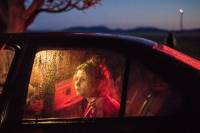
BRATISLAVA: The thriller The Cellar, directed by Russian Igor Voloshin and starring Jean-Marc Barr and Olga Simonova, has been acquired by London-based Starline Entertainment.
BATUMI: Eight projects including six from Georgian participated in the Alternative Way 2018, the industry platform of the 13th Batumi International Arthouse Film Festival, which took place from 19 to 23 September 2018.

The 25th Sibiu International Festival Astra Film, which will take place from 15 to 21 October, has announced relevant film industry personalities as the 13 members of the Jury for its 5 competition sections: International, Central and Eastern Europe, Romania, Shorts, and Docschool. The jurors will choose the winners out of 55 titles in competition from 30 countries, selected from over 3,000 submissions from 93 countries. Prizes amount to a total cash value of over 25,000 euros.
Pursuant to the second competition announced for the cinematographic works production co-financing, the Film Centre of Montenegro will, at the proposal of the Council, support the total of 22 projects in different categories: screenplay development, project development, feature and short documentary films, as well as feature and short feature films .
Screenplay and Project Development
The total of 4 projects received support in the project development competition. The Commission assessed that the project “Face of Honor”, directed by Nikola Vukčević, Galileo Production Company, represents a “well-prepared project with a clear concept, vision and strategy for further development. The project “Forever Hold Your Peace”, directed by Ivan Marinović, is a mentality comedy with great potential for cinema and festival placement, developed by an author who knows the environment in which the action takes place. The commission assessed the project “The Rear Admiral” directed by Mladen Ivanović, Production Company Artikulacija Film, as a courageous and important story with a clearly designed concept. The Commission assessed the project “Nehaj” by Milija Šćepanović, received funds for the script development.
A total of 5 synopsis received support at the competition for script development. The Commission noted that the synopsis “The Fall” of Aleksandar Bečanović represents a “potentially interesting genre film leaning on Hollywood’s best tradition from the time large film studios produced art films, which in terms of domestic cinematography represents a very innovative approach.” “History of Light” of Ognjen Spahić, was assessed as “an extremely shocking story with a clear author’s vision and a critical recollection of the past, told in an interesting and multiple layered way. “The Fear” by Željko Sošić, was recognized as “an intimate story about the modern world that is unstoppably crumbling in front of the eyes of the hero.” The Commission assessed the synopsis “The Day I Stopped Playing“ by Bojan Stijović as “a story of growing up and self-consciousness of heroes in a small environment that gets too close to him”, while “The Shot“ of Jovana Bojović was assessed as “a surprising family drama full of passion and turbulent psychological state of mind of the main characters.”
Feature and short documentary film
Pursuant to the Commission’s decision, total of 6 projects received support in the documentary film category. “The Last Nomad“, by Petar Glomazić, was assessed as “a seriously thought-out project with original authorial approach, full of honest poetry charge, with a clear line of vision in which the author’s commitment and his love for nature and man are felt.” The Commission assessed the project under the working title “Kosovo Refugees in Montenegro in 1999”, by the author Velibor Čović as a story of “three generations with a focus on the current situation of refugees in Montenegro, a project of rich research work, which through raw documentary corpus, is depicting the way we treated people as human beings, and not the nations at the times of crisis.”
The “Unadjusted, Film Count“, by the director Radoslav T. Stanisić, was assessed as “a television documentary which in the area of film and life creation incites memories of one of the most important Montenegrin and Yugoslav filmmakers, directors and professors – Milo Đukanović.” Pursuant to the Commission’s opinion, the project “EX-YU Rock Tragedies” by Danilo Marunović represents “interesting project dealing with the phenomenon of the tragic deaths of rock stars from the ex-Yu area”, requiring fine tuning thus the project received funds for the project development.
In the category of short documentaries, 2 projects received support. “We Are Sons of Your Rocks“ by Ivan Salatić in which the director, as the Commission assessed, through “a special authorial approach presented through the form of an experimental film, depicts three elderly men in search of the grave of an unknown Italian soldier shot and buried before the end of the WWII at the foot of the mountain Bjelasica.” “The Librarian“ by Branislav Milatović – which “with an interesting director’s approach explores the phenomenon of libraries in the 21st century, being told from the point of view of a librarian from Kotor, where the focus is placed on the rituals of a man who crosses the boundary of the ordinary and becomes something more than that.”
Feature and short feature films
The first competition for feature films production co-financing entailed also the presentation of projects before the Commission. All nine submitted projects were presented by the authors and producers before the Commission.
After reviewing the submitted documentation and presentations, the Commission decided to support a total of 6 projects. The project “Elegy of Laurel” by Dušan Kasalica, who received the project’s support for the project development, was assessed as an “extremely high-quality and stylishly consistently written project, with the intention to abandon drama and rely on emotional and poetic logic, with specific a directional approach aimed at offering innovative and original solutions.“ The project “Sirin”, directed by Senad Šahmanović, who was the successful applicant at the previous competition of the Centre in the category of project development, was assessed by the Commission as “a well-developed project with potential for international success confirmed through eminent workshops. The project of the working title “Skype”, directed by Ise Qosje, the Commission assessed as “a strong existential drama with striking characters and situations, with the authenticity of the ambience in the north of Montenegro, with precise scripting procedure and a clear directional vision”. The feature-length feature film “Breasts”, directed by Marija Perović, was assessed as “a unique female story told from the vision of three main characters, in which the author brings a simple, true and unpretentious story through tragic-comic elements.” The Commission assessed the project “Hit the Sky”, directed by Milutin Darić, as a story dealing with the universal theme of love, with the simplicity in the treatment of the elements. Pursuant to the Commission’s opinion, the project “Zaliv” by Draško Đurović, has a great potential, with a clear and precise director’s approach, which requires some alterations of the scenario, and for this reason the project received funds for project development. In the category of short films, the Commission has allocated funds to the project “The Aery“ of the director Milija Šćepanović.
In the following period, individual contracts will be concluded with the successful applicants, which will regulate the rights and obligations of the contracting parties, the payment schedule, the way of using allocated funds and other issues of importance.
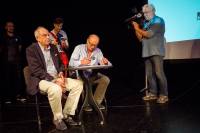
Polish National Film Festival is Gdynia to be the first national festival signing the Gender Quality pledge
Press releases 27-09-2018Women in Film – an informal Polish organization gathering over 3000 women working in the film industry – organized a conference entitled “50:50 by 2020” on Friday, 21 September 2018 during the Gdynia Film Festival.
Following the inspiring example of fellow women from all over the world and declarations signed in Venice, Toronto, and Locarno, Polish Women in Film have decided to propose a similar approach to Gdynia Film Festival management.
The Polish film industry is indisputably filled with remarkable female talent, such as: Agnieszka Holland, Małgośka Szumowska, and Jagoda Szelc. However, recent research conducted by dr Monika Talarczyk from Łódź Film School, which was commissioned by Krytyka Polityczna (Political Critique) on the basis of data analysed from the Polish Film Institute, leads to a damning conclusion: only 13% of the Polish Film Institute’s budget was allocated to female filmmakers in the last 12 years, which means that 87% of it was given to male directors. Women in Film has therefore decided to host a conference announcing these research findings as well as taking a comparative look at gender equality in film industry funding across Europe. Attendees include Iris Zappe Heller ( Deputy Director of the Austrian Film Institiute), Madelaine Ekman (Swedish Film Institute expert) and Peter Carpentier (Member Executive Committee of the Federation of European Audiovisual Directors).
Alongside international experts, dr Monika Talarczyk from Łódź Film School is going to present key findings from her analysis of data from the Polish Film Institute.
The general director of the festival Mr. Leszek Kopec alongside the writer/director Mr. Wojciech Marczewski Head of the Programming Board of the Festival signed the gender parity pledge announcing
- to present a schedule and plan of implementation of changes aiming to achieve parity in all decisive bodies of the festival: Programming Board, Selection Committee, Qualification Committee, Jury,
- to continue the transparency policy,
- to compile statistics of gender of the directors of all the films submitted to selection,
- to present, at the 44. Gdynia Film Festival, the results of actions taken by the Festival’s management in order to ensure gender parity.
The conference was supported by: Agnieszka Holland, Jagoda Szelc, Małgośka Szumowska, Klara-Kochańska-Bajon, Julia Kijowska, Anna Radwan, Sonia Bohosiewicz, Gabriela Muskała, Agnieszka Smoczyńska, Kasia Adamik, Olga Chajdas, Ewa Bukowska, Agnieszka Smoczyńska.
The opening speech was given by the leader of the movement Renata Czarnkowska-Listoś (producer) together with Małgorzata Szumowska. Absent Agnieszka Holland recorded her greatings to all guests and organizers. The closing speech was given by Ewa Puszczyńska, producer of “Cald War” who stated that’s important for women in the industry to stay united and the conference proved the strength of the women in the film industry.
Follow at: https://www.facebook.com/kobietyfilmu/
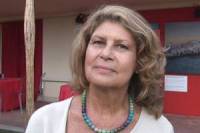
FNE TV: MEP Silvia Costa, EU Parliament Culture and Education Committee and Rapporteur for Creative Europe 2021-2027
Region 27-09-2018FNE asked Silvia Costa about the most important differences between Creative Europe 2021-2027 and the previous programme and the importance of the LUX Prix for European culture.
WARSAW: Fifteen films will vie in the international competition of the 34th Warsaw International Film Festival, which will take place from 12 to 21 October 2018.