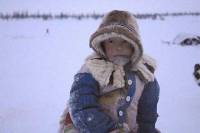
The Russian doc How Big is the Galaxy has picked up awards in Italy and France.
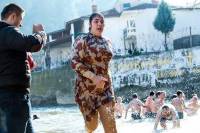
STRASBOURG: The European Parliament has awarded the 2019 LUX Film Prize Award to God Exists, Her Name is Petrunya by Macedonian director Teona Struga Mitevska. The award was presented at a ceremony and dinner on 27 November 2019.

TALLINN: The City of Tallinn is partnering with Tallinn Film Wonderland to construct a film industry centre, which will include three film studios and auxiliary spaces on Paljassaare peninsula in North-Tallinn.
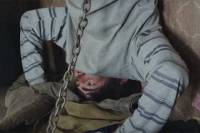
TBILISI: Giga Liklikadze’s low-budget debut feature film A Pig will screen in the Georgian Panorama section of the Tbilisi IFF, which opens on 1 December 2019. The film had its world premiere in the main competition of FilmFestival Cottbus in November.
TBILISI: Uta Beria’s debut feature Negative Numbers, the first Georgian/French/Italian coproduction, will be shown in the Georgian Panorama section of the Tbilisi Film Festival, which begins on 1 December 2019.
The Krakow Film Foundation, the organiser of the 60th Krakow Film Festival, announces the first titles of the next year’s anniversary programme! As it is the case every year, the top film-makers from all over the world come to Krakow to present their latest productions. In the international documentary film competition, we will see, among others, the opening film of the festival IDFA in Amsterdam, “Sunless Shadows” by Mehrdad Oskouei and the documentary film “My Father and Me” by the outstanding British film-maker, Nick Broomfield.
Nick Broomfield is one of the most frequently awarded British documentary film-makers in the world. During over 40 years of his artistic work, he observed the South American Nazis, met face to face with the infamous American serial killer Aileen Wuornos (on the basis of her life, the film “Monster” starring Charlize Theron was made), as well as confronted Courtney Love in connection with the circumstances of the death of Kurt Cobain. All these tasks were difficult, but according to the director himself, the most difficult film experience was documenting his own family history and his relationship with his father, famous British photographer, Maurice Broomfield, in the latest film “My Father and Me.”
 My Father and Me, dir. Nick Broomfield
Another hit of the anniversary edition of the Krakow Film Festival will undoubtedly be the latest film by Mehrdad Oskouei, one of the greatest Iranian documentary film-makers. “Sunless Shadows” is a shocking tale about young murderesses who serve their sentences of imprisonment in an Iranian prison for murdering their fathers, husbands or other family members. The unusual bond between the director and the characters in his film often leads to private confessions in front of the camera, dealing with the motives for the committed crimes, as well as the painful consequences. The camera observes the sincere conversations but also funny interactions of the incarcerated girls, for whom the prison reality sometimes does not seem to differ from the lives of ordinary teenagers. It also seems that the walls of the penitentiary and the hermetic company of other women are a kind of shelter from the society, aggressively dominated by men.
 Sunless Shadows, dir. Mehrdada Oskouei
Do not miss our first deadline - 30 November! Only for six days we will be waiting for films completed before 31 October 2019.
We are waiting for submissions of documentary, animated and short films to the three international competitions: for documentary films, for short films, to the DocFilmMusic competition presenting music documentaries, as well as to the national competition for Polish films.
The Krakow Film Festival is included in the prestigious list of film events qualifying for the Academy Awards in the short film category (feature film, animated film, documentary film) and feature-length documentary film category, and also recommends the films to the European Film Awards in the same categories.
Submit your film FILL IN THE FORM
The rules of submitting a film RULES AND REGULATIONS
The 59th Krakow Film Festival will take place on May 31 – June 7, 2020
Follow our news on the website and in the social media: Facebook, Twitter i Instagram.

Tallinn Black Nights and Vialog test audience and filmmakers engagement application
Festivals 26-11-2019For the 23rd edition, the Tallinn Black Nights Film Festival has teamed up with software developing company Vialog to test an audience engagement application on the festival's website, creating a unique channel for the audience to communicate with filmmakers directly.
Becoming the first A-category festival to test this kind of technology in full scope, Black Nights has worked with Vialog to integrate Virtual Q&As on the film pages of the festival website. This enables anyone to leave video comments and ask questions. There is no need to download any app, all website visitors on the film pages of Black Nights can use their laptop webcams or mobile phone cameras. This creates a niche platform for dialogue between the filmmakers, the audience and anyone else interested in joining the discussion.
The new solution is expected to provide a broader chance for focussed communication inside the film community as it will also enable guests who have already left the festival or those who didn't have chance to take part of the Q&A to have their voice heard by answering questions and comments and to set an ongoing discussion between filmmakers and their audiences.
It will also provide the festival valuable insight into the audience's reactions and thoughts on each of the programme entries. Vialog can thus extend in space and time the video dialogue of a given film, helping it reach a growing and engaged audience.
Says Hannes Aava, the head of communication and press of the Black Nights Film Festival: “We are ever-excited to try out new technologies at Black Nights and Vialog’s solution is something very unique and practical at the same time. We hope to gain some valuable insight from what our audience actually feels about specific films and provide everyone, not only people physically present at the Q&A's to join the discussions. I hope that our audience won’t shy away from this opportunity and we’ll have some engaging conversations in the festival community!”
The PÖFF Discuss platform is available during the festival at https://poff.ee/discuss
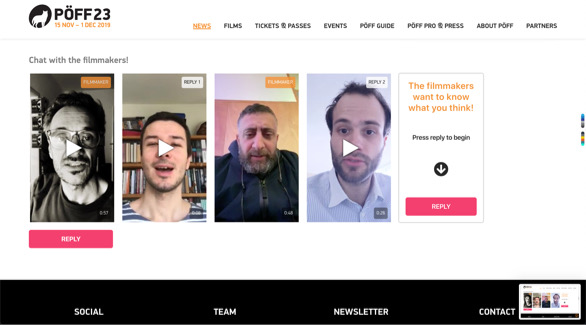
Vialog bar on the festival's website
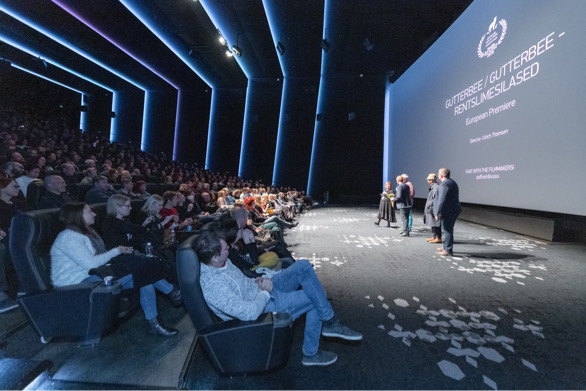
Black Nights screening of Gutter-bee

Black Nights screening of In the Strange Pursuit of Laura Durand
PRESS ACCREDITATION
Press accreditation for the 23rd Tallinn Black Nights Film Festival and Inudstry@Tallinn &; Baltic Event is in progress. Please apply by clicking on the link below.
APPLY FOR THE PRESS ACCREDITATION
PRESS OFFICE CONTACTS
The festival's press office gladly helps with any question regarding the accreditation, press screenings and conferences and helps to organise interviews with the festival's guests.
Press accreditations and events: This email address is being protected from spambots. You need JavaScript enabled to view it..
Press hospitality matters: Anna-Liiza Izbaš - This email address is being protected from spambots. You need JavaScript enabled to view it.
International communication: Hannes Aava - This email address is being protected from spambots. You need JavaScript enabled to view it. / +372 555 29 211.
Russian communication: Jaana Kalinistova - This email address is being protected from spambots. You need JavaScript enabled to view it..
Estonian communication: Tiit Tuumalu - This email address is being protected from spambots. You need JavaScript enabled to view it..
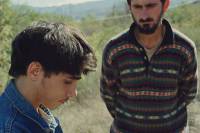
TBILISI: The Tbilisi IFF will open on 1 December with a screening of Alfred Hitchcock’s early work Blackmail. The festival will show six new domestic films in its Georgian Pamorama section.
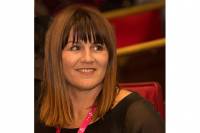
STRASBOURG: The Croatian producer Ankica Jurić Tilić will be given the Eurimages Co-production Award at the European Film Awards ceremony on Saturday, 7 December, in Berlin.

LIBEREC: The CEE Animation Forum, which takes place 5 – 8 May 2020, is accepting applications for animation projects through 10 January.