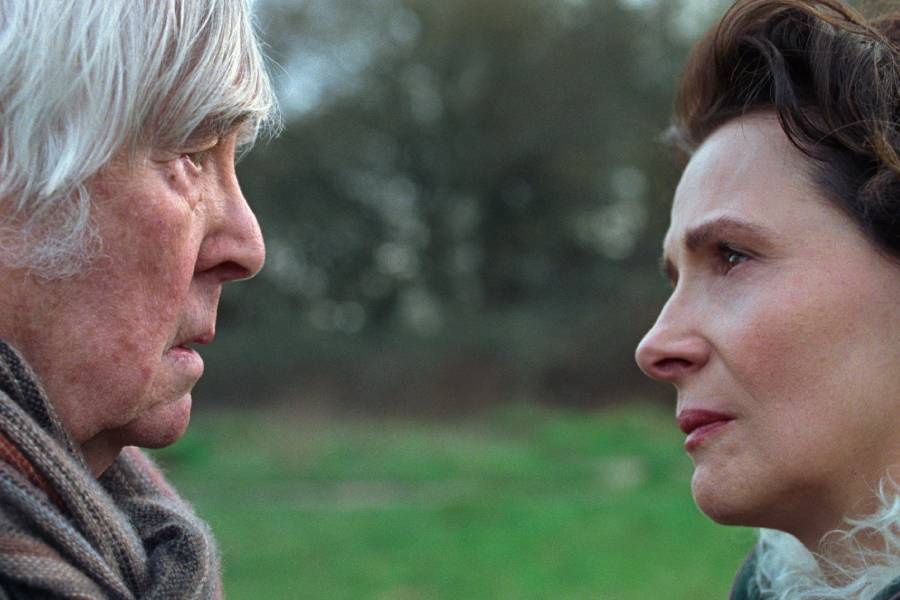
The film stars Juliette Binoche, Tom Courtenay and Anna Calder-Marshall, with younger actor Florence Hunt also playing a key role. Set largely in London, the story centres on Amanda, played by Binoche, who returns to the city with her teenage daughter to care for her mother Leslie, an artist suffering from advanced dementia. As the illness progresses, Leslie’s ability to communicate and make decisions about her own life fades, forcing those around her to grapple with difficult ethical questions.
The situation becomes even more complicated when Amanda discovers that her stepfather Martin continues to maintain a sexual relationship with Leslie despite her deteriorating mental state. Unsure whether her mother can give meaningful consent, Amanda contacts authorities, setting off a chain of events that brings the family’s private dilemma into the realm of law and public scrutiny. Through this conflict, the film examines the intersection of love, care, and personal freedom in the context of aging and illness.
Speaking during the festival press conference in Berlin, Binoche emphasized that the film addresses questions many families eventually face. “At a certain point, we have to go through all the questions about how we take care of our parents,” she said. “I’m going to get old at a certain point too, so those questions are important to anyone.”
For Hammer, Queen at Sea represents a long-awaited return to feature filmmaking. His previous film, Ballast (2008), premiered at the Berlinale nearly two decades earlier and won the Best Director prize at the Sundance Film Festival. After that early success, Hammer largely stepped away from directing features, focusing instead on teaching and developing projects before eventually returning with Queen at Sea.
During discussions at the Berlinale, Hammer described the project as a personal exploration of uncertainty and moral ambiguity. Reflecting on the film’s themes, he said he wanted “to make a film that reflects the uncertainty I feel myself,” referring to the difficult ethical territory surrounding care for aging parents and the limits of personal autonomy.
The production itself was an international collaboration between the United Kingdom and the United States, produced by Tristan Goligher for The Bureau. Principal photography began in London in April 2023, with cinematographer Adolpho Veloso shooting the film on 35mm. The visual approach, with its careful framing and restrained style, mirrors the emotional tension within the story.
In addition to its family drama, the film introduces a generational perspective through the character of Sara, Amanda’s teenage daughter, played by Hunt. Her experiences and relationships provide a contrast between youth and the fading memories of the older generation, highlighting the film’s broader reflection on the arc of life—from awakening desire to the gradual loss of identity.
With its world premiere in Berlin, Queen at Sea marked not only the return of Lance Hammer to the international festival scene but also a continuation of the Berlinale tradition of presenting films that confront complex social and moral questions. Through its exploration of aging, consent, and family bonds, the film contributed to the 2026 competition lineup with a story rooted in deeply human dilemmas.
Queen at Sea (UK/USA)
Director: Lance Hammer
Cast: Juliette Binoche, Tom Courtenay, Anna Calder-Marshall, Florence Hunt