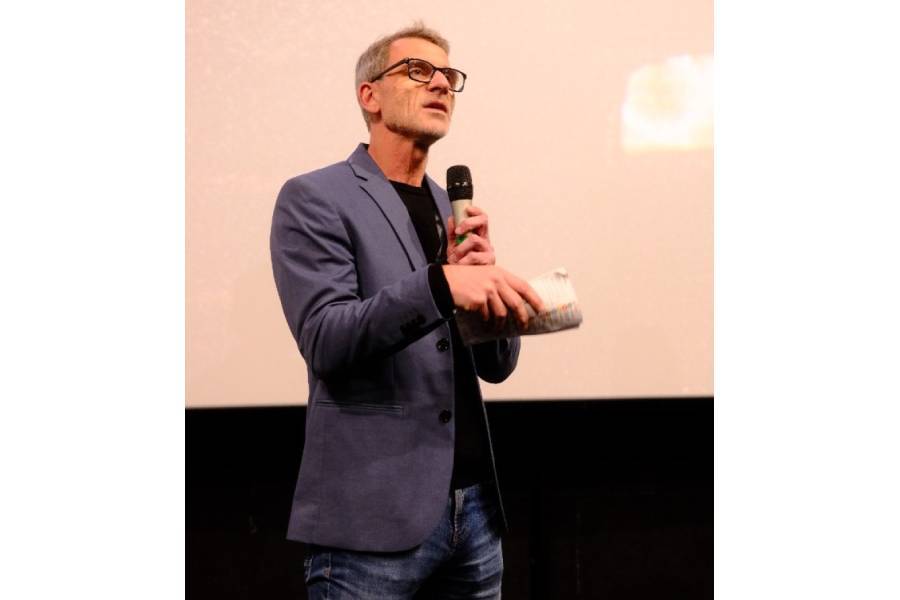
Hynek Dedecius is a Czech film festival organiser and translator based in Luxembourg. He is the co-founder and Artistic Director of CinÉast, the Central and Eastern European Film Festival in Luxembourg, where he oversees film programming and is involved in many other aspects of the festival's organisation, including communications, promotion, press relations and festival development.
CinÉast Film Festival Luxembourg 2026 will open with a Warm-up Weekend from 9 – 11 October, before its official opening on 14 October.
CinÉast 2026 is organised by CinÉast asbl in collaboration with the Kinepolis group, Cinémathèque, Neimënster, Cinextdoor network, Ancien Cinéma and others. Its main partners and sponsors include the Luxembourg Ministry of Culture, the City of Luxembourg, the Film Fund Luxembourg, the PwC Foundation Luxembourg, Kulczyk Investments, and the Polish Film Institute (pisf.pl). The festival is co-funded by the Creative Europe programme of the European Union.
FNE: What are the highlights and the innovations of the upcoming edition of the festival?
Hynek Dedecius: The 19th edition of CinEast has plenty to offer: 65 features and 60+ short films, around 40 international guests participating in Q&As and talks, six concerts, six ciné-debates (talks after films), exhibitions, a Focus on Bulgaria bringing together films, guests and special events, a Special Ukrainian programme including our own CinÉast 4Ukraine charity project, avant-premieres of films coproduced by Luxembourg, a retrospective of Andrzej Wajda, tributes to Allan Starski, Ildikó Enyedi, Andrzej Seweryn, and Petar Valchanov and Kristina Grozeva, as well as the first-ever presentation of Béla Tarr’s Sátántangó in Luxembourg. The programme also includes numerous screenings for children and teenagers, the major photography exhibition Crossroads, linked to this year’s festival theme, and CinÉast Pro, our industry event for producers, among many other highlights.
We are proud to present 11 films from Central and Eastern Europe submitted for the Oscars, bring to Luxembourg several films presented and awarded at Cannes, and welcome renowned Hungarian filmmaker Ildikó Enyedi as President of our International Jury.
We are also particularly honoured to welcome the leader of the Belarusian democratic opposition, Sviatlana Tsikhanouskaya, who will be our special guest at the debate Belarus at the Crossroads after the screening of Not Made for Politics, as well as former Luxembourg Minister for Foreign Affairs and Deputy Prime Minister Jean Asselborn, who will discuss Ukraine and the EU after the film The Eukrainian.
FNE: How did the festival evolve since its first edition in 2008?
Hynek Dedecius: CinEast has grown substantially since its first years, both in the size of the programme and in the number of countries featured. We started as a modest showcase of a few films from the four Visegrád countries (Poland, the Czech Republic, Slovakia and Hungary) and today we cover film productions from all post-communist countries of Central and Eastern Europe, with the exception of Russia, including Ukraine, Georgia and Moldova, as well as independent productions by directors from Belarus.
Since 2020, the festival has reached a stable scale of around 120 screenings every year, allowing us to focus increasingly on the quality, diversity and added value of the programme, by organising ciné-debates, inviting filmmakers, curating programmes for our country focuses, and presenting tributes, retrospectives and other special events. Our audience has reached 11,500 participants in 2025.
FNE: How is the selection made and what interests you in a film in order to select it?
Hynek Dedecius: Our goal is to bring the most interesting films produced in the featured countries to international audiences in Luxembourg, and we do our best to closely follow film production in these countries in order not to miss anything worth presenting. We have a network of national coordinators carefully monitoring films in development and newly released films, and we collaborate closely with national film centres, ensuring that we consider as many potentially interesting works as possible. We also follow the programmes of dozens of festivals, including small local ones. We do not rely solely on submissions but actively seek out and request films.
The selection committee then spends hundreds of hours watching and evaluating the films and discussing the final programme. We give preference to films with universal appeal, capable of speaking to audiences regardless of nationality, addressing themes our international festivalgoers can relate to, and offering new perspectives, ideas and emotions, while remaining open to bold and more niche productions. Quality is our first criterion.
Our aim is also to give a platform to talented emerging filmmakers, including through our Young Talents Competition, helping them gain visibility and create opportunities for their future careers.
FNE: In addition to film screenings, the concerts and music events are creating a friendly atmosphere for the audience. How easy or difficult is it to keep an audience engaged from one year to the next?
Hynek Dedecius: Since the beginning, CinEast has always sought to present the wider cultures of the featured region, while also creating opportunities for encounters and exchange. Festivalgoers can meet, talk and share ideas over a drink after Q&As or during our accompanying events, most notably concerts. We continue this tradition, organising six concerts this year, from our well-established Balkan music opening concerts (this year with Shantel) to jazz and DJ events, as well as two ciné-concerts (films presented with live soundtracks).
As regards our audience, we believe that we have built up a strong core of CinEast fans, but given the growing popularity of streaming services and the rich cultural agenda in Luxembourg, it is not always easy to bring people to the cinema.
This is why we have been exploring numerous ways to attract new audiences, especially young audiences and the local international community, through a varied programme, a strong range of accompanying events, and more targeted promotion and community engagement.
Since the COVID-19, our festival also features a modest online part with around 30 programmes available to watch at home. In addition, we have been organising “CinEast presents” screenings throughout the year to maintain the festival’s visibility between editions and help build new audiences.
FNE: Being so familiar with the CEE cinema, what trends did you notice lately and how do you think European cinema will evolve in the near future?
Hynek Dedecius: We believe that CEE cinema is in good shape, rich in creativity and talent, although there are clear financing constraints, with even internationally acclaimed filmmakers struggling to securing funding for new projects. To overcome this issue, we are witnessing a boom in coproductions: it is no longer rare to see six or more countries involved in producing a relatively modest film.
It is also encouraging to see that a growing number of CEE filmmakers are finding opportunities on the international stage, although working within larger international production structures can sometimes involve creative constraints that inevitably influence the final result. At the same time, we are excited to see emerging talents finding ways to create compelling work even with very limited or almost no budgets.
We hope that European cinema, also through its various co-financing mechanisms, will be able to retain its talent and continue bringing inspiring and valuable stories to our cinema screens. We do our best to support this.