Set in 1949, the narrative follows Thomas Mann as he travels from the United States back to a Germany still emerging from the aftermath of war. Invited to participate in cultural commemorations and public lectures, Mann’s return is initially framed as ceremonial. However, as the journey unfolds, it becomes increasingly personal. He is accompanied by his daughter Erika Mann, and together they navigate a landscape marked by both historical rupture and fragile reconstruction.
The film is structured as a series of encounters rather than a linear biopic. Mann moves between public appearances—lectures, receptions, and brief political engagements—and private moments of reflection with Erika. These quieter sequences form the emotional core of the film, revealing tensions within the Mann family itself, particularly in relation to exile, artistic responsibility, and loss. The absence of his son Klaus Mann, whose life ended in exile, is a recurring presence in the narrative, shaping the emotional weight of Mann’s return.
According to materials released during the Cannes Film Festival, Pawlikowski described Fatherland as “a film about returning to a place that exists only in fragments of memory.” He emphasized that the project was not intended as a conventional biography, but rather as a meditation on how historical figures experience time differently once they have been displaced from it. “Thomas Mann is both inside and outside his country at the same time,” he noted in press notes distributed at Cannes.
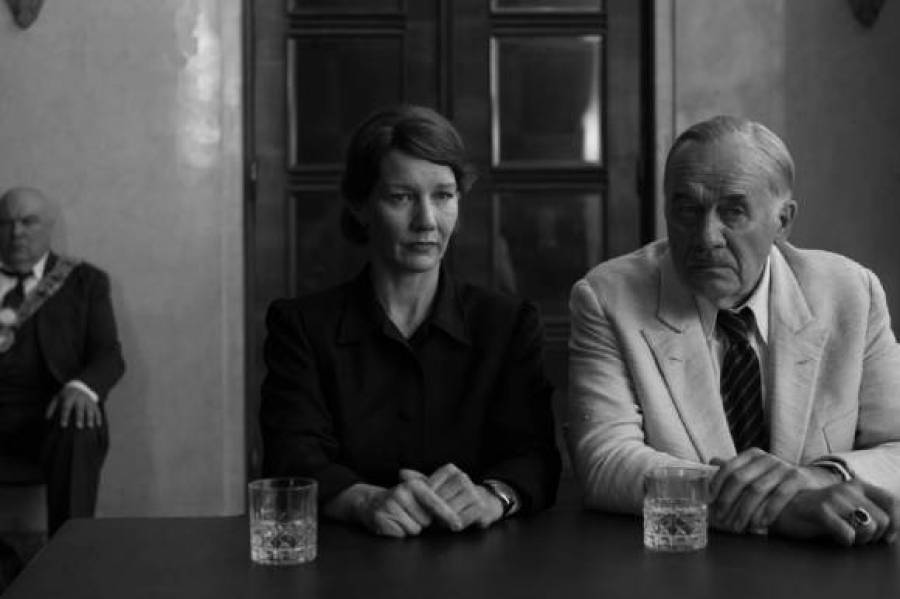
The film continues Pawlikowski’s established visual and narrative approach, known from earlier works such as Ida and Cold War, though here applied to a broader historical canvas. Shot in a restrained monochrome palette, Fatherland emphasizes spatial distance and compositional stillness. Landscapes, train compartments, lecture halls, and hotel rooms are framed with deliberate precision, reinforcing the sense of a man observing his surroundings as if through a lens of detachment.
Sandra Hüller, who portrays Erika Mann, plays a central role in shaping the film’s emotional structure. Her character acts as both interlocutor and interpreter of her father’s experience, often challenging his reflections while also grounding him in the present moment. During the Cannes press conference, Hüller remarked: “Erika is not simply accompanying her father—she is constantly negotiating between loyalty and clarity. She sees what he tries not to say.”
The Cannes press conference also highlighted Pawlikowski’s interest in the tension between public intellectual life and private emotional history. He stated: “Mann is a public figure everywhere he goes, but in this film, I was interested in what happens when the public mask no longer protects him from memory.”
Rather than presenting a conventional chronological biography, Fatherland constructs its portrait of Thomas Mann through fragmented impressions, emphasizing moments of hesitation, observation, and silence. The result is a depiction of return not as resolution, but as a continued negotiation with the past.
At Cannes 2026, the film was noted for extending Pawlikowski’s exploration of historical memory while shifting toward a more expansive narrative form, situating Fatherland as both a character study and a reflection on how writers themselves become part of the histories they attempt to record.
Pawlikowski’s filmography has long been defined by intimate, stylized portraits of individuals navigating personal and historical dislocation. His earlier works include My Summer of Love (2004), The Woman in the Fifth (2011), Ida (2013), which won the Academy Award for Best Foreign Language Film, and Cold War (2018), which received widespread acclaim for its minimalist storytelling and striking black-and-white cinematography. Fatherland continues this artistic trajectory while adopting a broader temporal canvas and a more ensemble-driven narrative.
Visually, Fatherland continues Pawlikowski’s collaboration with Żal in crafting meticulously composed imagery, often using stillness and negative space to reflect emotional distance between characters. The film frequently lingers on objects—photographs, rooms, and landscapes—that function as carriers of memory, reinforcing the idea that history is assembled from fragments rather than complete narratives.
Credits:
Fatherland (Italy, Poland, France, Germany)
Directed by Paweł Pawlikowski
Produced by Our Films
Coproduced by Extreme Emotions, Nine Hours, Circle One
Supported by the Polish Film Institute (PISF), among others