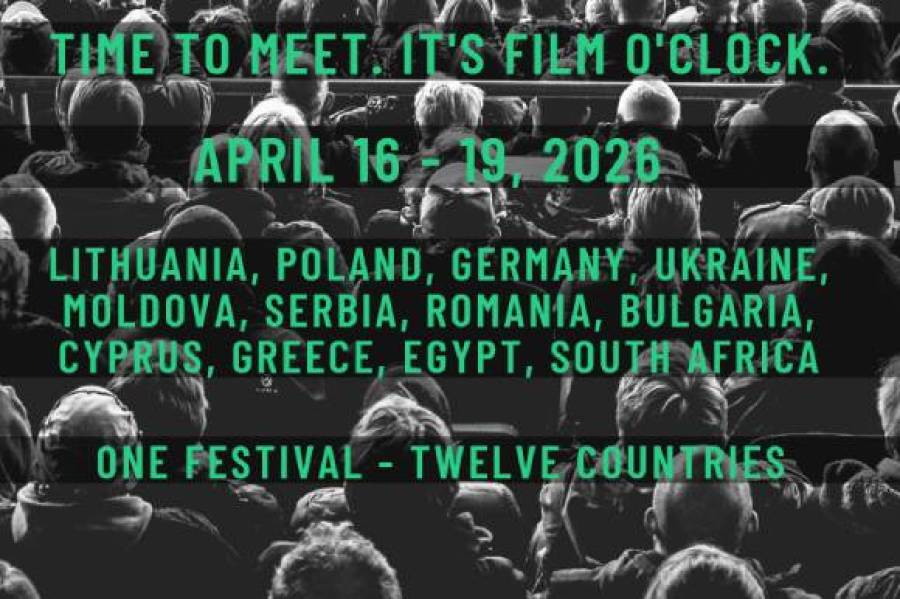
The event features screenings, conferences and networking sessions.
The international short film competition includes 16 films from the participating countries, which were selected from among the submitted titles.
The programme also includes several screenings of classic works such as Bulgarian The Peach Thief (1964) by Valo Radev, Yugoslavian Man Is Not a Bird (1965) by Dušan Makavejev, and Polish The Maids of Wilko (1979) by Andrzej Wajda, as well as several conferences.
The festival opens with an online conference about the contemporary curatorial practices, followed by the synchronised screening of Cristi Puiu’s founding title of the New Romanian Cinema Stuff and Dough / Marfa si banii (2001).
In Romania the screenings will be hosted by the Eforie Cinematheque in Bucharest.
The partners of the festival are universities and film schools, UNATC (Romania), Wits School of Arts (South Africa), Vilnius Academy of Arts (Lithuania), as well as national archives and film institutes in Lithuania, Ukraine, Egypt and Poland.
Film O'Clock International Festival was initiated and it is led by Romanian filmmaker and researcher Mirona Radu, and it is produced by Creatrix Fama with the support of ABI-Fundatie, and co-financing from Romania’s Administration of the National Cultural Fund (AFCN).
“At its heart, this edition of Film O’Clock explores the intersections between works, both through intentional curatorial pairings and the conversations they generate. As festival director, I realise, after several editions, that the way partnerships are formed increasingly reflects a shared set of values. The festival is becoming more grounded precisely because it is defining its own identity. Over the years, Film O’Clock has grown from 5 to 12 participating countries across Europe and Africa. At this stage, our focus shifts from expansion to deepening these connections, investing more meaningfully in the relationships and exchanges within these territories”, Mirona Radu told FNE.
She also spoke about the launch of a new initiative within the festival, the Film Industry Hub: “We are building a space where archives, film schools, cinephiles, and filmmakers empower one another, and where exchange becomes as important as the screenings themselves. This approach is reflected in this year’s panels, as well as in the launch of the Film Industry Hub, an initiative that speaks directly to the festival’s commitment to connection and collaboration. The Hub is currently in development and will be presented this year across three festivals in Europe and Africa. It extends the conversation beyond the temporal limits of the event and reinforces Film O’Clock’s transnational dimension, rooted in its core mission: encouraging connections beyond borders”, Mirona Radu added.
International Short Film Competition:
Alișveriș (Romania)
Directed by Vasile Todincă
Alma en Route (South Africa)
Directed by Jana-Marie Hey
Ark (South Africa)
Directed by Johann Vermaak
Can You Hear Me? (Poland)
Directed by Anastazja Naumenko
Critical Condition (Germany)
Directed by Mila Zhluktenko
Followers (Moldova)
Directed by Kol Lyubov
Fox Feather (Romania)
Directed by Vlad Popa
Glitter Kiss (Lithuania)
Directed by Auguste Gerikaite
Grandpa Is Sleeping (Romania)
Directed by Matei Branea
Land of Salvation (Greece)
Directed by Ifigenia Dimitriou
My Brother, My Brother (Egypt, France, Germany)
Directed by Saad Dnewar, Abdelrahman Dnewar
The Granny (Bulgaria)
Directed by Aleksa Trayanova, Kalina Dimitrova
The Sky Is Falling (Egypt)
Directed by Mostafa Gerbeii
The Visit (Cyprus)
Directed by Louis Patsias
Unavailable (Ukraine, France, Belgium, Bulgaria, the Netherlands)
Directed by Vladyslav Makariuk
Upon Sunrise (Serbia, Spain, Slovenia, Croatia)
Directed by Stefan Ivančić