Held at the Polish Institute in Berlin as part of the 20th edition of filmPOLSKA – Polnisches Filmfestival, the pitching session was aimed at producers, sales agents, distributors and other industry professionals looking for new projects and emerging filmmaking voices from Poland.
The projects presented are now seeking a range of international opportunities, including minority coproduction, sales and distribution partnerships, postproduction support, and regional financing.
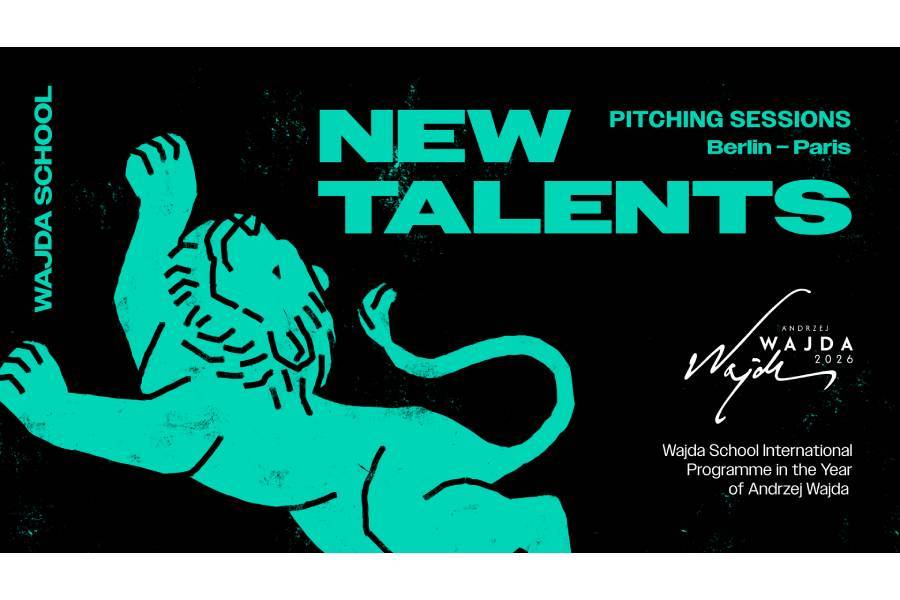
WAJDA SCHOOL NEW TALENTS | Berlin project is implemented as part of the Wajda School International Programme in the Year of Andrzej Wajda. The Patron of the Programme is the Polish National Fundation. The project is co-financed by the Ministry of Culture and National Heritage from the Culture Promotion Fund and by the Polish National Fundation. The project partner is Adam Mickiewicz Institute and the project co-organiser is Polnisches Institut Berlin. The project is carried out in cooperation with: festival filmPOLSKA. FilmFestival Cottbus, connecting cottbus, and JAZZRADIO.
Pitching as Part of Development
Beyond the potential for concrete partnerships, the Berlin session highlighted the value of pitching as a development tool.
Elisabeth Lehmann, who works exclusively in documentary, praised the quality and preparation of the projects and emphasised the importance of smaller industry meetings as a place where filmmakers can develop their pitching skills.
“Presenting a film in its sensitive early development stage to an audience requires courage and confidence,” she said. “And if you want to secure funding for your projects, you need to be able to pitch effectively. That is something that requires practice.”
Paul Rieth likewise pointed to the development value of the format, particularly the opportunity to test how a project is perceived outside its creative team.
“I was impressed by the overall level of development of the projects, and particularly enjoyed how different they were in terms of subject, approach and cinematic language,” said Rieth.
He described the pitches as “an invitation to engage with projects that are still developing”, rather than finished statements.
For Rieth, this exchange can be particularly useful during development. “A pitch is not only about convincing someone or securing financing. It is also an opportunity to test how a project is perceived: What resonates? What creates curiosity? Where do questions arise? Is the positioning clear?”
Two Documentaries, Two International Propositions
The two documentaries in the selection also demonstrated very different approaches to finding an international audience.
Lehmann sees Short Stories about Lucia, Agnieszka Iwańska’s film about writer Lucia Berlin, as a project with global potential. The story, she noted, can be approached as a family history, a portrait of an underrecognised writer, a story of addiction and motherhood, or one of emancipation.
Wrestler, directed by Kajetan Żakowski, takes a more intimate, character-driven approach. Lehmann highlighted the project's cinematography while noting that its wider accessibility will depend on establishing a strong dramatic arc and stakes that can engage audiences beyond the world of wrestling.
“If the narrative succeeds in establishing a clear dramatic arc, with both highs and lows, and if the audience understands what is at stake for the protagonist, it has the potential to become a universal story that resonates beyond its specific setting,” she said.
From Berlin to Paris
The next international presentation will take place in Paris on 3 December 2026 in collaboration with Arras Film Festival and Arras Days, giving the selected filmmakers another opportunity to meet potential partners as their projects progress towards their next stage.
The Six Projects
Komputer
A psychological thriller by Tomasz Wróbel, set in 1969 Warsaw, where a scientist developing a pioneering computer with chatbot capabilities discovers that the machine is beginning to display increasingly advanced intelligence.
The Return
Weronika Piaścik’s psychological drama follows a former midwife returning from Germany to the Polish seaside, where helping her pregnant sister forces her to confront the death of her own son.
Short Stories about Lucia
Agnieszka Iwańska’s arthouse documentary explores the life of writer Lucia Berlin through the perspective of her son, touching on family, motherhood, addiction and the writer’s posthumous literary recognition.
Tapiwa’s Story
Kamil Dąbrowski (script) cross-cultural psychological drama follows a young Zimbabwean activist who moves to Poland after killing a man in self-defence and becomes caught between his new life, legal status, relationships, and an unresolved past.
Wrestler
Kajetan Żakowski’s documentary follows professional wrestler Jakub Granecki as he leaves his corporate career behind to pursue wrestling in Poland’s underground scene, while an approach from a WWE scout offers the possibility of a major career change.
The Prophet
Zbigniew Szczerbetka (script) historical psychological drama centres on Adam Mickiewicz and his involvement with a self-proclaimed prophet and his cult, while a bisexual opera singer becomes entangled with the poet and his wife. The project is planned as a feature film, with additional potential for an eight-part series.